
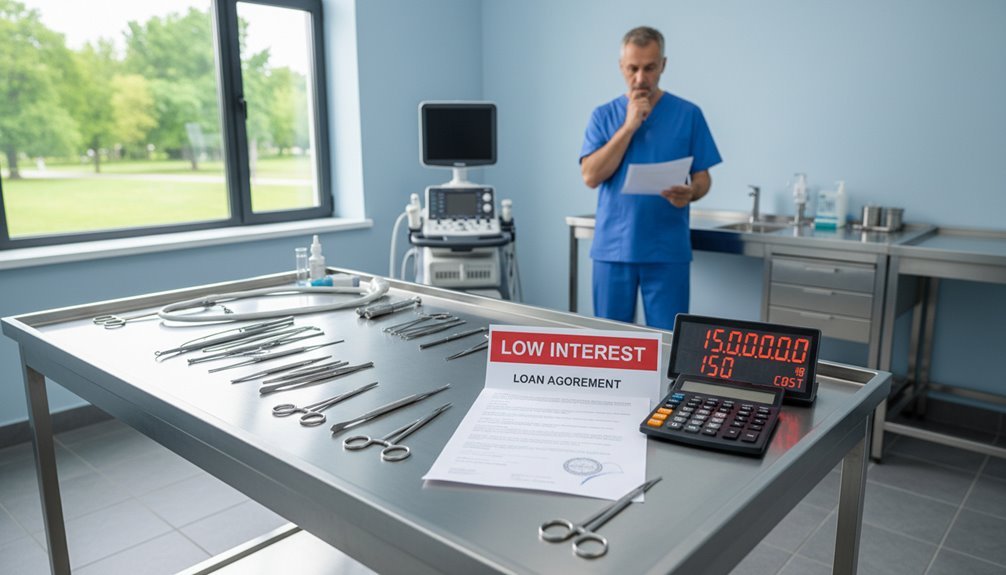
You’re fixated with that advertised interest rate, but you’re missing the real money drain: hidden fees, mismatched loan terms, and bundled costs that aren’t getting factored in. Your portable ultrasound shouldn’t carry the same financing timeline as surgical equipment, yet most lenders slap generic terms in everything. Section 179 deductions and asset-based lending strategies could save you thousands, but they’re barely mentioned during your initial pitch. Stick around to unearth what your lender isn’t telling you.
Matching Loan Types to Clinical Needs

You’ve probably noticed that not all equipment is created equal—a portable ultrasound machine you’ll replace in five years needs different financing than a surgical table that’ll outlast your clinic’s mortgage. When you’re matching loan types to your actual clinical needs, you’re fundamentally asking yourself whether you’re buying a tool that generates revenue immediately (like diagnostic gear that justifies premium pricing) or investing in foundational infrastructure that supports your entire operation. The secret is understanding that a short-term lease works great for tech that evolves constantly, while traditional loans make sense for durable assets, and that your existing inventory can sometimes serve as collateral to access better terms than a bank would normally offer. Additionally, choosing between new, refurbished, or leased equipment depends on your budget and desired financing flexibility options.
Veterinary equipment financing for high-turnover diagnostic tools
Because diagnostic tools wear out more quickly than your clinic’s coffee maker, matching the right loan with the right equipment isn’t just smart—it’s critical for keeping your practice lean and competitive. Your veterinary technology financing strategy should align each tool’s lifespan with your loan term. Here’s what you’re actually working with:
| Equipment | Useful Life | Loan Term | Best Financing |
|---|---|---|---|
| Digital Radiography | 4-5 years | 48-60 months | Tech Refresh Lease |
| Ultrasound Machine | 6-7 years | 60-84 months | Hybrid Lease |
| Surgical Suite Equipment | 10+ years | 120+ months | Traditional Loan |
| Software Subscriptions | Annual | 12 months | Operating Lease |
| Portable Diagnostic Tools | 3-4 years | 36-48 months | Equipment Line |
Mismatch your timeline, and you’re paying for yesterday’s technology tomorrow.
Why surgical equipment leasing requires different terms than software
While a software subscription renews every twelve months and becomes obsolete the moment a better version drops, your surgical suite’s equipment is built to outlast your entire practice—which means treating them like interchangeable assets is a recipe for financial headaches. Surgical equipment leasing demands longer terms, typically 5-10 years, because these machines hold their value and reliability. Your anesthesia machine isn’t going anywhere. Software? It’s essentially digital sand. When you’re structuring surgical equipment leasing agreements, you’re protecting against technological obsolescence differently than you would with a practice management system. Align your lease terms with the equipment’s actual lifespan, not industry hype. A surgical laser justifies a 7-year commitment; cloud software doesn’t.
Loans improve practice efficiency: Calculating revenue per procedure
The real payoff from equipment financing isn’t the machine itself—it’s what you can do with that which your competitors can’t. When you calculate revenue per procedure, you’re tracking the real impact from your investment. Let’s say you finance a $40,000 ultrasound unit. If it increases your diagnostic accuracy, you’ll charge more per exam and handle more cases weekly. Suddenly, that $800 monthly payment generates $4,000 in new revenue. Loans improve practice efficiency by freeing capital you’d normally hoard for emergencies. You’re not just buying equipment; you’re buying capacity. Track your numbers before and after installation. The data proves it: financed gear pays for itself through operational gains your bank account can actually feel.
Asset-based lending for vets: Using existing inventory as collateral
Most vets don’t realize they’re sitting in a goldmine for collateral every single day. Your existing diagnostic equipment, surgical instruments, and even your drug inventory can release capital through asset-based lending for vets. This approach lets you utilize what you’ve already invested in to finance new upgrades without maxing out traditional credit lines.

Here’s the genius part: lenders evaluate your current assets’ value and lending capacity based on that tangible collateral, not just your personal credit score. Your ultrasound machine, surgical suite, and pharmaceutical stock become your financial utility. You’re fundamentally converting dormant asset value into working capital for innovation.
This strategy works beautifully when you’re upgrading equipment or expanding services. You’re not starting from zero—you’re building upon what you’ve already proven works.
The Hierarchy of Veterinary Lenders
When you’re hunting for equipment financing, you’ve got options that range from your local credit union to state-of-the-art fintech platforms, and each one plays by different rules—so knowing which lender fits your clinic’s needs is half the battle. Traditional commercial banks might offer you rock-bottom rates if your practice looks good in writing, but they’ll make you jump through hoops; meanwhile, specialized veterinary lenders understand your cash flow patterns and can move swiftly, even if their rates sit a bit higher. The real question isn’t which lender’s the “best,” but which one aligns with your timeline, credit profile, and whether you’d rather deal with a handshake from a local credit officer or get approved by an algorithm in 48 hours.
Best lenders for veterinarians needing prime rates
Not all lenders treat veterinary practices the same way, and that difference shows up quickest in your interest rate. You’re competing against yourself when you don’t know who’s actually designed to finance vets.
The best lenders for veterinarians understand your unique cash flow patterns and diagnostic needs:
- Veterinary-specific equipment financiers offer rates customized for practice revenue, not just your personal credit score.
- Credit unions with agricultural lending divisions often beat traditional banks by 1-2% because they get what you do.
- Online fintech platforms underwrite swiftly and focus on practice metrics rather than paperwork delays.
- Captive finance arms from equipment manufacturers occasionally offer promotional rates that turn into your competitive edge.
The difference between 6% and 9% in a $50,000 loan? That’s $9,000 staying in your pocket, not theirs.
Commercial veterinary lending banks vs. online fintechs
You’ve got two fundamentally different worlds competing for your equipment financing dollar, and they operate in opposite playbooks. Traditional banks move slowly but profoundly—they’ll dig into your personal credit, tax returns, and practice financials like they’re solving a puzzle. They’re cautious, which means predictable rates and terms you can count upon.
Online fintechs? They’re sprinting. They’re algorithm-driven, focusing on your practice’s cash flow and revenue patterns rather than your FICO score. Approval happens in moments, not weeks. The trade-off: rates might be steeper, but speed costs money. Your best veterinary lenders often aren’t pure-play banks or pure-play fintechs anymore—they’re hybrids. They’ve learned that vets need both reliability and velocity.
Equipment finance companies specializing in medical assets

Because traditional banks and fintechs each have their blind areas, a third category has emerged to fill the gap: equipment finance companies that specialize exclusively in medical and veterinary assets.
These niche lenders understand your world in ways generalists never will:
- They speak your language—they know ultrasound machines, surgical lasers, and dental units without you explaining what they do.
- They move quickly—approval happens in moments, not weeks, because they’ve already priced the risk.
- They’re flexible regarding terms—they’ll match loan length to equipment lifespan, preventing you from financing outdated tech.
- They bundle soft costs—installation, training, and software subscriptions get wrapped into one payment.
You’re not negotiating with someone reading a checklist; you’re working with someone who’s financed hundreds of practices like yours.
Comparing specialized veterinary financial services against local credit unions
When you’re standing in your clinic at 3 p.m. during a Thursday afternoon, realizing your ultrasound machine just died and you’ve got emergency appointments booked for the following day, the speed from your lender matters more than their reputation. Specialized veterinary financial services understand it—they recognize your world. Local credit unions? They’re asking questions about collateral while you’re hemorrhaging revenue. Veterinary-focused lenders approve equipment financing in days, not weeks, because they’ve already assessed what your practice generates monthly. Credit unions treat you like a standard business borrower, slowing everything down with generic underwriting. You need partners who recognize that your diagnostic capability directly impacts your income stream. Speed isn’t luxury—it’s survival.
Critical Decisions: Ownership vs. Usership
When you’re facing the moment for upgrading your clinic’s diagnostic arsenal, you’ve got to decide whether you’re building permanent assets or staying nimble with technology that won’t become a $40,000 doorstop in four years. The choice between owning equipment outright, leasing it, or financing with zero down isn’t just about monthly cash flow—it’s about whether you want to be locked into yesterday’s tech or free to pivot when something better hits the market. Let’s break down what each path actually costs you and which one makes your practice—and your wallet—happier in the long run.
Lease or buy veterinary equipment: A strict cash flow analysis
The moment you uncover that sleek new ultrasound machine at a conference, your brain splits into two voices: one whispers “buy it and own it forever,” while the other nervously calculates whether your practice can actually afford the monthly payment. Here’s where lease or buy veterinary equipment decisions get real:
- Leasing preserves cash flow—you’re paying for usage, not ownership, keeping emergency funds intact for staffing or emergencies.
- Buying builds equity—after the loan’s paid, that machine’s yours, generating pure profit without monthly obligations.
- Technology obsolescence matters—leases protect you from outdated equipment; ownership leaves you stuck with yesterday’s tech.
- Tax timing amplifies savings—Section 179 deductions favor purchases before year-end, potentially offsetting the entire acquisition cost through tax benefits.
Your choice depends on whether you’re optimizing today’s cash or tomorrow’s assets.
Medical device leasing advantages for upgrading technology
You’ve weighed the math regarding buying versus leasing, and you’re starting to see the appeal of keeping cash in your account instead of tied up in equipment that will be obsolete before you’ve paid that off. Medical device leasing flips the script entirely. You’re not locked into outdated technology for seven years—you are upgrading whenever better tools hit the market. That new ultrasound with AI-assisted diagnostics? You can swap that in without the guilt of abandoning a half-paid machine. Your monthly payments stay predictable, which makes budgeting easier. Additionally, maintenance and software updates are typically included, so you’re not caught off-guard by repair bills. This is ownership without the obsolescence hangover.
Veterinary practice loans for permanent asset acquisition
There’s a fundamental fork in the road every veterinary practice eventually faces: do you own the equipment outright, or do you rent the gear for as long as you need it?
Veterinary practice loans for permanent asset acquisition offer distinct advantages:
- Build equity—monthly payments change into ownership, creating tangible practice assets that strengthen your balance sheet.
- Tax advantage—Section 179 deductions slash your tax burden when you own the equipment, not lease it.
- Long-term cost savings—a surgery table financed over ten years costs far less than perpetual lease payments.
- Operational control—you dictate maintenance schedules, upgrades, and replacement timing without vendor restrictions.
Ownership isn’t just about possession; it’s about building a practice with real financial depth that survives market shifts.
Zero down payment options and their impact on monthly margins
While this is tempting for one to think that zero down payment financing is a gift from the lending gods, this is actually a calculated trade-off that’ll reshape your monthly cash flow in ways you need for understanding before signing. Here’s the reality: zero down payment options sound magical until you see your monthly margins shrink. You’re not avoiding costs—you’re spreading them across every payment, meaning higher interest accumulation. That $50,000 ultrasound? You’ll pay notably more over time. The lender recovers their risk through your monthly bill, not your upfront commitment. Your cash stays intact, but your practice bleeds profitability monthly. Strategic thinking requires balancing immediate liquidity against long-term expense. Sometimes, putting money down actually maximizes your margins.
Financing by Practice Lifecycle Stage

Your practice isn’t one-size-fits-all when it comes to financing, so whether you’re launching your initial clinic with minimal track record or you’re a seasoned operator eyeing your third location, lenders have customized solutions that match where you actually stand. From startup loans that focus on your business plan and personal credit to expansion financing that zeros in regarding your existing cash flow, the lending environment recognizes that a five-year-old practice needs something totally different than a brand-new grad hanging up a shingle. We’ll walk through each stage—including what to do if your credit’s taken some hits along the way—so you can secure the right capital without overpaying or getting trapped in terms that don’t fit your reality. Exploring different funding avenues can help you identify the most suitable financial strategy for your veterinary practice.
Startup veterinary loans: Securing capital with limited history
Starting a veterinary practice is like being asked for performing surgery without having operated before—except the patient is your entire business, and the stakes are your life savings. You’re facing a paradox: lenders want proof you’ve succeeded, but you’re just beginning. Here’s how you break through:
- Leverage your veterinary degree as collateral—it’s proof of competency.
- Build relationships with SBA lenders who specialize in professional startups.
- Use personal assets strategically to secure startup veterinary loans without drowning in interest.
- Document your business plan obsessively—lenders fund vision when numbers back it up.
The truth? You’re not asking for charity. You’re asking for partnership. Lenders who understand veterinary medicine know your equipment generates revenue immediately. That’s your superpower.
Small business vet loans for established clinic expansion
Once you’ve proven your practice can survive and thrive, the lending game changes entirely. You’re no longer fighting an uphill battle—you’re negotiating from a position of strength. Small business veteran loans for established clinics operate differently because lenders now see your track record. They’re analyzing your revenue trends, client retention rates, and profit margins instead of sweating your personal credit score.
This is where you utilize your success. Lenders compete for your business, offering better rates and quicker approval timelines. You can finance that second ultrasound unit or upgrade your surgical suite without depleting reserves. Your cash flow history becomes your prized asset, releasing capital that lets you expand strategically rather than merely surviving month-to-month. It’s ultimately working in your favor.
Practice expansion loans for multi-site acquisitions
Proving you can run one successful clinic is impressive; proving you can run two is a whole different ballgame—and lenders are aware of that. Multi-site acquisition demands a different financing approach altogether. Here’s what separates success from overextension:
- Consolidated cash flow analysis — Lenders examine combined revenue across all locations, not just individual clinic performance, to assess repayment capacity.
- Operational redundancy requirements — You’ll need documented management systems proving you can handle multiple sites without burning out.
- Cross-collateralization options — Practice expansion loans often tie together existing and new locations, creating stronger security for lenders.
- Scaled debt service ratios — Banks expect higher profitability percentages when you’re borrowing for growth, not replacement equipment.
The reality? Multi-site financing isn’t harder—it’s just more strategic.
Bad credit equipment financing: Options for distressed clinics
While a pristine credit score opens doors at traditional banks, a struggling clinic doesn’t have the luxury of waiting for your finances to heal—your patients need care today, and your equipment failures won’t reschedule themselves. Bad credit equipment financing exists specifically for you. Specialized veterinary lenders now evaluate your practice’s cash flow and revenue potential rather than obsessing over your personal FICO score. They understand that a temporary financial hiccup doesn’t reflect your clinical competence or earning path. These lenders offer higher rates, sure, but they’re willing to work with distressed clinics that traditional banks reject outright. The trade-off? You get the ultrasound machine today instead of six months from now, and you start generating revenue immediately. That’s the innovation that keeps your practice alive.
The Fine Print in Veterinary Technology Financing
You’re about to sign at that dotted line, and while the interest rate catches your eye, the real game-changers hiding in veterinary equipment financing are the tax timing strategies, the fixed versus variable rate traps, and those sneaky costs that aren’t technically part of the loan but absolutely drain your budget. Understanding Section 179 deductions, decoding whether your rate locks in or floats with the market, noticing what “100% financing” actually covers, and strategically timing your payments during equipment setup can mean the difference between a smart investment and a financial headache that haunts your clinic for years.
Section 179 tax benefits: Timing your purchase for maximum deduction
Why does December 31st feel like a deadline only following Thanksgiving? Because Section 179 tax benefits don’t care about your timeline—they care about yours. Here’s what you’re missing:
- You can deduct up to $1,220,000 in equipment purchases immediately, not over years
- Timing matters: Purchase before December 31st to claim the deduction for that year’s taxes
- New and used equipment qualify, so don’t wait for the perfect machine
- Your cash flow improves instantly when you pair financing with tax deductions
Strategic vets aren’t just buying equipment; they’re using Section 179 tax benefits to change acquisition costs into tax savings. That ultrasound you’ve been considering? Buy it now, deduct it fully, and let the tax write-off subsidize your investment.
Veterinary loan rates: Fixed vs. variable exposure
Most veterinarians don’t realize that the interest rate they lock in today can either save them thousands or cost them thousands over the duration of their equipment loan—and the distinction between fixed and variable rates isn’t just fine print; it’s the difference between predictable cash flow and sleepless nights.
Fixed veterinary loan rates anchor your payments. You’re protected against market swings, which means your monthly budget stays stable whether interest rates climb or plummet. Variable rates, meanwhile, start lower but drift upward when the economy shifts. That seemingly attractive 4.5% variable offer? That could hit 7% by year three, tanking your profitability calculations.
Here’s the reality: you’re financing diagnostic capability, not gambling on rate trajectories. Lock in fixed rates, control your destiny.
Hidden costs in 100% financing available offers
While that “100% financing attainable” banner hanging above the lender’s website looks like a golden pass, the reality is that it’s actually a trap door disguised as generosity. You’re not actually financing 100%—you’re financing the sticker price along with invisible charges that’ll make your head spin.
Here’s what they’re hiding in veterinary equipment financing:
- Origination fees (2-5% out of loan amount) buried in closing docs
- Documentation and processing costs ($500-$1,500) mysteriously labeled as “administrative”
- Equipment insurance requirements you didn’t negotiate, tacked onto monthly payments
- Software licensing bundles mandatory for equipment operation, financed separately at premium rates
That low advertised rate? It only applies after you’ve already paid thousands in hidden costs in 100% financing attainable offers. You’re not getting a deal; you’re getting played.
Deferred payment structures: managing cash flow during installation
Now that you’ve identified the hidden fees lurking in those “100% financing” offers, here’s the plot twist: even after you sign at the dotted line, your cash flow challenges aren’t over—they’re just shifting into a new phase. Many deferred payment structures let you delay payments during installation—sounds great, right? But here’s the catch: interest still accrues while your equipment sits idle. You’re paying for something you’re not yet using. Smart lenders structure these so payments align with when the equipment generates revenue. Before accepting deferred terms, calculate your actual installation timeline and revenue ramp-up. Some practices find that starting payments immediately, even during setup, costs less overall than deferring. The real innovation? Negotiate payment schedules tied with your diagnostic income increases, not just calendar dates.
Specific Funding Protocols for Major Assets
When you’re financing a major asset like an X-ray machine or ultrasound system, you’ve got to know that the equipment price tag isn’t the whole story—software integration, installation, training, and those ongoing subscriptions can easily add another 30% onto your total investment. You’ll want lenders who understand that bundling these costs into a single amortization schedule makes way more sense than scrambling for patchwork financing that leaves you short when the technician shows up for training your staff. The key is finding a partner who structures loan terms around the actual useful life of your equipment, not some cookie-cutter timeline that has you paying for outdated tech long after the replacement has occurred.
X-ray machine financing: Handling software integration costs
Most vets think about the X-ray machine itself—the box, the tube, the console—but they forget that modern digital radiography is really software running within expensive hardware, and that’s where financing gets tricky.
When you’re exploring x-ray machine financing, don’t let lenders convince you that the equipment price is the whole story. Here’s what actually matters:
- PACS integration costs can run $5,000–$15,000 to connect your system to practice management software
- Annual licensing fees for image storage and cloud backup consume another $2,000–$4,000 yearly
- Installation and calibration aren’t included in the base quote—budget an extra $3,000–$8,000
- Staff training programs guarantee you’re not sitting with a $50,000 paperweight
Smart lenders now bundle these soft costs into total financing packages. Demand it.
Ultrasound equipment loans: Bundling probes and training
Unlike X-ray machines that sit in one room doing one job, ultrasound systems demand flexibility—you’ve got multiple probes for different anatomies, software that communicates with your entire practice, and technicians who need to know what they’re doing before a client arrives with an emergency. Smart ultrasound equipment loans bundle everything together: the machine, probes for small animals and large animals, integration costs, and—this is essential—hands-on training. You’re not just buying hardware; you’re buying capability. Most vets miss this. They finance the unit alone, then scramble to pay separately for probe sets and staff training, which eats into your cash flow. Progressive lenders understand this reality and offer thorough packages that treat ultrasound as a complete diagnostic ecosystem, not isolated segments.
Clinics upgrade medical technology: Funding the total project cost
The bundled ultrasound approach we just covered is really just the warm-up act—this is the playbook for thinking bigger. When you’re upgrading your entire diagnostic suite, you need veterinary business loans that actually cover everything:
- Hardware costs – the machines themselves (CT scanners, digital radiography systems, ultrasound units)
- Installation and setup – electrical work, imaging software integration, calibration
- Staff training – because expensive equipment sitting idle generates zero ROI
- Ongoing support – software licenses, maintenance contracts, equipment updates
Most lenders fund only item one. You’re left cobbling together separate financing for the rest. That’s expensive and inefficient. Forward-thinking lenders now bundle these into total-project-cost financing, letting you scale your capabilities without piecing together a financial puzzle.
Veterinary capital equipment: Amortization schedules that make sense
Once you’ve locked in financing for your diagnostic suite upgrade, here’s what separates vets who sleep soundly at night from those who stress over every payment: matching your loan term with how long that equipment actually remains useful.
Your veterinary capital equipment won’t all age the same way. That surgical table? Finance it for ten years—it’ll outlast your career. But digital radiography systems? They’re obsolete in four years, so don’t saddle yourself with a seven-year loan on yesterday’s technology.
The trick’s aligning amortization schedules with asset lifecycles. You’re not just paying interest; you’re strategically timing when that debt ends relative to when replacement becomes inevitable. Smart scheduling keeps cash flowing and prevents carrying debt regarding dead equipment.
Speed and Documentation Requirements

You’ve probably noticed that traditional banks move at a glacial pace, but veterinary-specialized lenders understand your urgency—they know that a broken ultrasound machine doesn’t wait 30 periods for approval, and neither should you. The trick is finding lenders who’ve built underwriting systems specifically for vet practices, which means they already know what documentation actually matters (your practice’s cash flow and patient volume) instead of demanding the same generic paperwork a pizza chain would need. When you work with industry experts rather than generalists, you’re not just speeding up approval; you’re also getting approval regarding deals that would’ve been automatic rejections from a lender who doesn’t understand why your equipment investment directly translates to higher revenue.
Fast approval vet loans: What underwriters need today
Speed in veterinary equipment financing isn’t a luxury anymore—it’s a bare minimum expectation. Today’s rapid approval vet loans move at digital speed, not banker speed. You’re competing against lenders who approve in 24 hours, not weeks.
Here’s what underwriters scrutinize now:
- Bank statements (last 3 months) – They want proof of consistent cash flow, not promises
- Practice tax returns – Two years minimum to verify revenue stability and growth path
- Equipment specifications – Details matter; they’re evaluating resale value if things go south
- Debt-to-income ratio – Your existing obligations versus what you’re requesting
The game’s changed. Traditional FICO scores matter less than your practice’s actual financial pulse. Modern underwriters trust data over credit history. Have your documents ready before you apply—that’s your real competitive advantage.
Fast funding speeds vs. due diligence delays
While lenders promise 24-hour approvals, they’re simultaneously demanding more documentation than ever before—and that’s actually a good thing for you. Here’s the paradox: quick funding speeds sound incredible until you realize you’re rushing through incomplete applications. Modern underwriters want your last two years of tax returns, detailed P&L statements, and 90 days’ worth of bank statements. Sure, it feels tedious, but this thoroughness protects you from predatory terms.
| What You’ll Need | Why It Matters |
|---|---|
| Tax returns | Proves actual income |
| Bank statements | Shows cash flow stability |
| P&L statements | Demonstrates profitability |
| Equipment quotes | Justifies loan amount |
| Practice metrics | Reveals revenue potential |
The real innovation? Lenders using algorithms to process documentation more quickly, not skip it. You’re getting speed *and* diligence—the ideal location for securing better rates.
Industry-specific underwriting: Why generalists deny valid applications
Because most loan officers work with restaurants, retail shops, and manufacturing plants, they don’t understand how veterinary practices actually generate income. They’re analyzing your application through a generic lens, missing what makes your clinic tick. Here’s why industry-specific underwriting matters:
- They misread your cash flow—veterinary revenue spikes seasonally and varies by service type, not typical business patterns.
- They don’t value your diagnostic equipment ROI—a new ultrasound increases your invoice average by 40%, but generalists see only the debt.
- They overlook your recurring revenue—wellness plans and preventive care create predictable income streams they can’t classify.
- They ignore your competitive moat—advanced equipment keeps clients loyal in ways spreadsheets don’t capture.
Specialized lenders get it. They approve what generalists deny.
Customized financial solutions for complex ownership structures
Now that you’ve found a lender who actually understands your veterinary practice, there’s another layer to navigate—and that’s one that catches a lot of vets off guard.
Your ownership structure matters. Whether you’re a solo proprietor, operating an S-corp, running a partnership, or managing a multi-location entity, generic lenders stumble. They don’t speak your language.
Customized financial solutions account for your specific setup. A vet lender recognizes that your partner’s credit profile shouldn’t tank your equipment approval. They understand that your newly formed LLC needs different documentation than an established practice.
The right lender tailors approval timelines and collateral requirements for your actual situation. This isn’t just quicker—it’s smarter. You’re not forcing your practice into a box; the financing adjusts to you.
Acquiring Capital Without Breaking the Bank
You’ve got options that won’t drain your practice’s emergency fund, and that’s where smart financing becomes your competitive edge. Whether you’re eyeing competitive interest rates that beat your local bank or structuring flexible repayment terms that sync with your seasonal revenue spikes, veterinary lenders understand your cash flow challenges in ways traditional lenders simply don’t. The real win comes when you see how the right equipment—financed strategically—actually pays for itself through increased diagnostics and client revenue, turning what feels like debt into an investment that generates profit.
Competitive interest rates: Benchmarking current offers
What’s the difference between a 5% interest rate and an 8% interest rate regarding a $50,000 equipment loan? Over five years, you’re looking at roughly $6,500 in extra interest—money that could’ve funded your staff’s continuing education instead.
Here’s how to benchmark commercial veterinary lending offers effectively:
- Compare APR, not just rates — Annual percentage rates reveal hidden fees that quoted rates often hide.
- Request amortization schedules — See exactly where your money goes each month across different lenders.
- Evaluate terms beyond interest — Prepayment penalties, equipment obsolescence clauses, and technology refresh options matter tremendously.
- Leverage your practice metrics — Lenders increasingly value revenue-per-veterinarian over your personal credit score, so highlight your clinic’s cash flow strength.
You’re not just shopping for financing; you’re negotiating your practice’s financial future.
How to finance vet equipment while preserving working capital
The real challenge isn’t finding money for purchasing that ultrasound machine—it’s finding money for acquiring that without watching your emergency fund disappear like a dog treat at a training class. Equipment acquisition loans structured specifically for veterinary practices solve these problems by separating your operational cash from your capital investments. Instead from depleting reserves, you’re spreading costs across predictable monthly payments that align with the revenue the equipment generates. The key is choosing lenders who understand veterinary cash flow patterns and offer flexible terms. By preserving your working capital, you maintain the financial cushion needed for payroll, medications, and unexpected emergencies while still upgrading your diagnostic capabilities and competitive positioning.
Vets acquire diagnostic tools: ROI case studies
When Dr. Rodriguez financed a $45,000 ultrasound system, she wasn’t gambling—she was investing. Here’s how smart vet clinic financing enhances diagnostic tools into revenue engines:
- Immediate diagnostic wins: She captured soft tissue injuries competitors missed, charging $200+ per advanced scan.
- Client retention increase: Pet owners chose her practice because she could answer their questions same-day, not weeks later.
- Staff efficiency improvements: Her team completed 30% more cases monthly, reducing bottlenecks that plagued the old equipment.
- ROI acceleration: The $800 monthly payment paid itself back within six weeks through increased services.
Your diagnostic tools aren’t expenses—they’re investments that multiply. Smart vet clinic financing allows you to practice medicine at the level you trained for, not the level your budget permits.
Flexible repayment terms: Aligning payments with revenue cycles
Because your clinic’s revenue doesn’t arrive in neat, predictable chunks, your equipment payments shouldn’t either. Flexible repayment terms align your financing with how you actually earn money—seasonal surges, weekend emergencies, and all. Instead from fixed monthly payments that strangle cash flow during slow periods, you’re matching loan installments with your revenue cycles.
| Payment Model | Best For | Monthly Impact |
|---|---|---|
| Seasonal Adjustments | Equine/exotic practices | High summer, low winter |
| Revenue-Based Payments | Mixed-animal clinics | Scales with gross receipts |
| Deferred Start Terms | New equipment rollouts | Grace period before payments |
| Seasonal Deferral | Emergency-heavy practices | Skip winter months |
| Blended Hybrid | Multi-service clinics | Combines fixed + variable |
This approach isn’t just smart financing—it’s survival strategy.
Frequently Asked Questions
How Does Equipment Financing Impact My Personal Credit Score Versus My Business Credit Profile?
You’d think equipment financing tanks your personal credit, yet it doesn’t. You’re building business credit instead—lenders now prioritize your practice’s cash flow metrics over your personal FICO, releasing larger approvals more quickly.
What Happens to My Loan if My Practice Gets Acquired or Merged With Another Clinic?
Your loan typically shifts to the acquiring entity through an assumption agreement, though they’ll reassess your terms. You’ll want pre-acquisition financing clarity to strengthen your negotiating position and prevent operational interruption during changeover.
Can I Refinance Equipment Mid-Loan if Interest Rates Drop Significantly or My Credit Improves?
You can refinance mid-loan, but you’ll maneuver prepayment penalties and closing costs that often negate interest savings. Your best move? Negotiate refinance terms upfront when signing the original contract.
Are There Penalties for Early Payoff, and Does It Affect My Ability to Finance Future Equipment?
You’ll find most veterinary lenders don’t penalize early payoff—they’re banking upon interest accumulation. Paying early actually strengthens your business credit profile, positioning you favorably for larger equipment financing rounds ahead.
What Tax Implications Exist if I Sell Financed Equipment Before the Loan Term Ends?
You’ll face depreciation recapture taxes regarding the gain between the sale price and your adjusted basis. You’re liable for ordinary income tax rates regarding that recapture, along with you’ll still owe the remaining loan balance to your lender.

Gerry's commitment to helping businesses thrive is evident in his track record of providing tailored financial guidance. He understands the unique challenges that companies face and is dedicated to finding innovative solutions to support their growth.
When he's not working with clients or exploring the dynamic world of business financing, Gerry enjoys staying updated with industry trends and sharing his insights through informative articles. His passion for empowering businesses with financial knowledge is a driving force behind his work.
Connect with Gerry Stewart to tap into a wealth of financial expertise and unlock opportunities for your business's success.



