

You’re facing textile’s classic cash crunch: you need inventory upfront, but retailers pay later.
Purchase order financing solves that by letting lenders pay your suppliers directly, freeing up your capital for production without draining your reserves.
Top options like Hilldun Corporation, King Trade Capital, and Rosenthal & Rosenthal specialize in apparel brands, offering advances up to 100% of costs.
They evaluate your customer’s creditworthiness instead of yours, making qualification easier.
Stick around to uncover which option fits your brand best.
Key Takeaways
- Purchase order financing enables textile businesses to access working capital by converting supplier invoices into immediate funds without waiting for customer payments.
- Leading providers like Hilldun Corporation, King Trade Capital, and Rosenthal & Rosenthal offer specialized solutions tailored for textile manufacturers and wholesalers.
- Qualification criteria typically include customer creditworthiness, proper documentation, healthy gross margins, and established relationships with credible suppliers.
- PO financing covers up to 100% of COGS, including raw materials and transportation costs, supporting seamless production scaling without depleting cash reserves.
- Combining purchase order financing with early payment discounts, accounts receivable factoringSelling accounts receivable (invoices) to a third party at a, and letters of credit optimizes cash flowThe net amount of cash moving in and out of a business. and operational resilience.
The Seasonal Squeeze: Why Textile Cash Flow Is A Balancing Act
Because fashion moves more rapidly than your cash can keep up, you’re stuck in a timing problem that traditional financing just won’t solve. During peak seasons like back-to-school and holidays, demand surges force you to build inventory quickly, but your retailers won’t pay for 60 nights after delivery. Leveraging flexible financing solutions tailored to production cycles can help bridge this gap.
Meanwhile, suppliers demand upfront payments for materials and labor. That gap between what you owe and what you’ll receive creates the “Seasonal Squeeze.” Your seasonal inventory capital gets locked in production while cash reserves drain. Without consistent revenue above $33,000 monthly, your fixed overhead costs become increasingly difficult to cover, compounding the cash crisis.

That’s where textile industry financing through purchase orders becomes your secret weapon. Garment manufacturing credit tied directly to confirmed retail orders lets you fund production without waiting for customer payments. You’re no longer choosing between growth and survival.
How Purchase Order Financing Works For Apparel Brands
When you land that dream retail order, you’re not just signing a contract, you’re revealing a financing opportunity that turns your supplier’s invoice into immediate working capital. PO financing lets you fund everything from raw fibers to finished garments by leveraging your customer’s creditworthiness rather than your own balance sheetA financial statement summarizing a company's assets, liabil, which means you can bridge that brutal 16-week production gap without burning through cash or maneuvering the maze of international letters of credit solo.
The real magic? You’re fundamentally borrowing against a guaranteed sale, so lenders care way less about your personal credit and way more about whether your retailer will actually pay. This approach is particularly effective for businesses facing demand spikes or seasonal fluctuations, as the financer pays your suppliers directly, alleviating the immediate cash flowThe net amount of cash moving in and out of a business. burden and allowing you to maintain operational momentum.
Funding From Fiber To Finished Garment
Once you’ve landed that dream retail order, the real challenge begins, figuring out how you’re actually going to pay for that. That’s where apparel supply chain funding steps in. PO financing covers everything from your fabric procurement loans through final delivery, meaning you’re never stuck choosing between declining orders and draining your bank account.
| Stage | What’s Funded |
|---|---|
| Raw Materials | Fiber sourcing and fabric production |
| Manufacturing | Labor, equipment, and processing |
| Logistics | Shipping and warehousing costs |
| Delivery | Finished goods for your customer |
Your lender pays suppliers directly while you focus on fulfilling orders. Once your retailer pays their invoice, funds flow back to you minus fees. This clothing brand working capital approach lets you scale confidently without touching your credit lines. With advances up to 100% of COGS, you can cover not just production costs but also shipping, duties, taxes, and transportation without straining your cash reserves.
Navigating International Letters Of Credit (LCs)
If you’re sourcing fabric from India or manufacturing garments in Vietnam, you’ve probably heard the term “letter of credit” thrown around like it’s the secret handshake of global trade—and honestly, it kind of is.
An LC is your bank’s written promise to pay your supplier once you’ve submitted the right documents. Here’s why it matters for fashion trade finance: your exporter gets paid security, you get proof of shipment, and everyone sleeps better at night.
For textile import-export finance, an LC acts as a neutral middleman, reducing defaultFailure to repay a debt according to the terms of the loan a risks while enabling CMT production loans to flow smoothly.

The process? Your retailer confirms an order, you request an LC from your bank, and suddenly your manufacturer trusts you enough to start production immediately. No deposit required. Payment is made only when your shipment and accompanying documents comply with the LC terms, ensuring complete alignment between what you’ve ordered and what actually arrives.
Bridging The 16-Week Production Gap
Bridging The 16-Week Production Gap
You’ve landed the order for a lifetime—a major retailer wants 50,000 units from your collection—but here’s the catch: you need $2 million upfront for paying suppliers and manufacturers, and you won’t see a dime from the retailer for 16 weeks after shipment.
This is where sustainable textile funding through PO financing steps in. Instead of draining your bank account, a lender covers your production costs while you focus upon what you do best: creating. Here’s how the gap disappears:
- Financier pays your supplier immediately for materials and labor
- Your manufacturer produces and ships according to schedule, no delays
- Retailer receives goods and processes payment towards the lender
- You get funded balance minus fees, ready for the next order
You’re scaling without sacrificing your vision. The purchase order financing market is projected to grow from $5.5 billion in 2023 to $12.9 billion by 2033, making this an increasingly accessible solution for textile brands managing large orders.
11 Best Purchase Order Financing Options For The Textile Industry
When you’re ready in order to turn that dream retail order into reality, you’ve got options—and not all PO lenders are created equal. We’ve identified five powerhouses that specialize in textile financing, each with their own ideal location depending upon whether you’re a boutique brand scaling quickly, an international manufacturer juggling multiple currencies, or a wholesaler moving serious volume.
Let’s break down which lender actually fits your business so you can stop leaving money above the table. The right PO financing partner can bridge your cash flowThe net amount of cash moving in and out of a business. gaps while you wait for invoice payments, allowing you to accept larger orders without financial strain.
1. Hilldun Corporation: Best Overall For Fashion And Apparel Brands
Most fashion brands don’t know that Hilldun Corporation’s been quietly solving the cash flowThe net amount of cash moving in and out of a business. crisis since 1958, basically, they’ve been around longer than quick fashion itself. They’re the secret weapon behind iconic names like Tommy Hilfiger, Marc Jacobs, and Golden Goose.
Here’s what makes them stand out:
- Immediate funding after you ship orders, so you’re not waiting 60+ intervals for retailer payments
- Smart credit evaluation concerning your buyers, meaning they handle the risk if major retailers stall
- Flexible lines of credit that automatically grow as your business scales
- Separate DTC financing for direct-to-consumer sales, keeping your channels independent
With four decades of fashion know-how, Hilldun understands your Tech Packs and production timelines. The company currently works with over 120 brands selling to major retailers like Saks and Neiman Marcus, providing the financial stability that independent designers desperately need in today’s challenging retail environment.
They’re not just lenders, they’re partners who actually know the industry’s quirks and pressures.
2. King Trade Capital: Best For International Textile Manufacturing
If your factories are in Asia and your retailers are in America, King Trade Capital’s been solving that puzzle for 32 years, and they’re genuinely good at that. They fund payments directly to your overseas manufacturers when shipment happens, which means your factories don’t wait 30-60 weeks anymore. That acceleration keeps your looms humming and your production in schedule.
King Trade Capital structures deals from $2.1MM to $22MM, scaling with your growth. They’ve backed athleisurewear companies landing $9MM facilities and New York brands capturing national chain orders.
The real win? Your factories run at full capacity while you capture bigger contracts. They handle the heavy lifting of international payments, so you focus on what you do best: building your brand.
3. Rosenthal & Rosenthal: Best For High-Volume Textile Wholesalers
Scale demands a different kind of financing partner, one that comprehends your business isn’t just about landing orders, but about moving massive inventory without getting strangled by working capital constraints. Rosenthal & Rosenthal gets it.
They’ve financed textile operations for over a century, and they’re built for wholesalers like you who think big.
Here’s what they bring to the table:
- 100% advance rates regarding your cost of goods, meaning you’re not hunting for extra capital
- Facilities up to $12 million designed for high-volume operations that scale rapidly
- Letters of credit and purchase guarantees that fund both overseas and domestic suppliers flawlessly
- Intercreditor agreements that play nicely with your existing factoringSelling accounts receivable (invoices) to a third party at a relationships
They handle freight, duties, and logistics costs within your financing package. No surprises. No friction. Just capital that moves as swiftly as your inventory does.
4. SouthStar Capital: Best For Fast-Growth Sustainable Fabric Brands
You’ve built something special, a sustainable textile brand with eco-certified fibers, ethical sourcing, and a product that retailers actually want. Now comes the hard part: funding the dream without giving away your company.
SouthStar Capital gets it. They’re built for brands like yours, handling everything from manufacturer payments to shipping logistics. You submit a purchase order from a creditworthy retailer, and they advance 100% of production costs, no caps, no restrictions.
After delivery, they shift smoothly into accounts receivable financing, advancing 70-90% of invoice value while you retain your margins.
Their secret? They verify customer creditworthiness upfront and manage the entire fulfillment process, reducing your risk. This means you’re scaling sustainably without equity dilutionThe reduction in ownership percentage of existing shareholde. Your gross margins fuel growth, not investor demands.
5. Liquid Capital: Top Choice For Small-To-Mid-Market Garment Makers
when your supplier demands a 50% deposit before cutting a single yard of fabric, and your retailer won’t pay for 60 periods after delivery, that’s when most small-to-mid-market garment makers hit a wall.
Liquid Capital changes that equation. They’ve built their entire model around garment makers like you, brands stuck between supplier demands and retailer timelines. Here’s what makes them different:
- Fund up to 100% of product costs while goods travel from factory into warehouse
- Skip the equity conversation entirely, they focus around your customer’s creditworthiness instead
- Combine PO financing with A/R factoringSelling accounts receivable (invoices) to a third party at a so you’re covered from production through customer payment
- Access local decision-makers who actually understand textile economics
You’re not just getting capital, you’re gaining a partner who speaks your supply chain language.
6. SMB Compass: Best For Boutique Apparel Startups
Most boutique apparel startups face the same heartbreaking moment: you’ve landed your initial real retail order, the buyer’s credit is solid, and suddenly you’re staring at a supplier who wants 50% upfront before they’ll touch your fabric. That’s where SMB Compass steps in.
They specialize in financing POs for brands like yours—the ones with confirmed orders but empty bank accounts. You’ll get up to 100% financing for orders ranging from $10K to $2M, with decisions in 24-48 hours. No equity dilutionThe reduction in ownership percentage of existing shareholde. No personal guarantees required.
Their pay-as-sold model means you repay only after your retailer pays you. They fund suppliers directly, so you skip the cash-flow nightmare entirely.
With no minimum credit score and 30% cost savings versus traditional lenders, SMB Compass lets you scale confidently without drowning in debt.
7. 1st Commercial Credit: Best For Large-Scale Fabric Importers
While SMB Compass serves the boutique brands scrapping together their initial retail win, 1st Commercial Credit operates in a different arena, one where the orders aren’t measured in thousands but in millions, and the supply chains stretch across oceans.
Here’s what makes them your secret weapon for scaling:
- Rapid funding cycles: Pre-approval in 24-48 hours means you’re not watching your window for opportunity close
- Flexible coverage: They fund raw materials, labor, import duties, and logistics without requiring a separate lender for each segment
- Ocean-spanning reach: Perfect for USA importers paying overseas suppliers, turning international complexity into your competitive advantage
- Staged payment options: Match funding to production milestones, keeping cash flowing exactly when you need it
With rates between 1.5-5% monthly and minimum orders around $100,000, you’re accessing growth capital that doesn’t dilute your equity.
8. Milberg Factors: Best For Fashion Industry Credit Protection
DefaultFailure to repay a debt according to the terms of the loan a risk is the silent killer in textile deals. You’ve landed that massive order from a big retailer, your production line’s humming, and then they file for bankruptcy before payment arrives.
That’s where Milberg Factors steps in as your safety net. They’re credit protection specialists who’ve perfected the art of protecting fashion brands from retail customer defaults.
What makes them stand out? They handle the tough credit approvals that traditional insurance won’t touch, manage collections quietly behind the scenes, and keep you informed with real-time industry knowledge.
You’re basically trading worry for peace of mind. When you’re scaling orders aggressively, knowing your receivables are protected lets you focus on what you do best: creating exceptional products without losing sleep over payment risk.
9. Star Funding: Best For Finished Apparel Goods Procurement
When you’re sitting on a purchase order from a major retailer but your bank account‘s looking lean, Star Funding is the partner who understands that, literally, because they’ve been financing garment makers since before most fashion brands even existed.
Founded in NYC’s Garment District by a former manufacturer, they’ve spent over 30 years excelling in the apparel game.
Fund up to 100% of your finished goods costs without draining cash reserves
Skip the week-long waiting game—they’ll fund your initial PO in as little as seven periods
Cover everything: fabrics, trims, duties, freight, and complex multi-supplier arrangements
Lock in early payment discounts from suppliers while maintaining your margins
Their letters of credit and cash advances keep your production moving while you wait for retailer payment.
10. PurchaseOrderFinancing.com: Best For Multi-Stage CMT Production
Cut, make, trim, ship—if you’re juggling multiple production stages while your cash flow’s stuck in neutral, PurchaseOrderFinancing.com is built exactly for your situation. They understand that apparel manufacturing isn’t a straight line, it’s a complex dance of sequential steps, each demanding payment before the next begins.
Here’s the magic: they pay your suppliers directly through letters of credit, keeping production moving without you fronting capital. You’re not waiting weeks for approvals—funding arrives in moments.
They handle everything from cutting through final invoice collection, freeing your cash for critical expenses when you need it most.
With advances up to 100% of supplier costs and PO limits reaching $25 million, you’re scaling without sacrificing control. No personal credit required, just a solid customer PO. That’s growth in your terms.
11. Hana Financial: Best For Specialized Textile Trade Finance
While PurchaseOrderFinancing.com handles the multi-stage production dance, you’ll find that some textile operations need a partner who speaks the language of global trade, someone who’s been doing that since before rapid fashion even had a name.
Hana Financial has been that partner since 1994. As a top-ten U.S. factoringSelling accounts receivable (invoices) to a third party at a company with $1.5 billion in annual volume, they’ve excelled in what textile brands actually need:
- Letters of credit and documentary collections that move international shipments without delays
- Credit approvals for foreign accounts backed by their expansive global database
- Bespoke solutions designed for your specific apparel goals, not generic spreadsheets
- Industry veterans who’ve visited your suppliers and understand CMT costs beyond the numbers
Your executives get 45 years of combined textile experience working your growth strategy.
How To Qualify For Textile PO Funding In 2026
Five key qualification factors stand between you and the cash you require to fulfill that dream order, and the good news is that you probably already possess most of them.
First, lenders evaluate your customer’s creditworthiness, not just yours. A purchase order from a reliable retailer? That’s your key opportunity.
Lenders evaluate your customer’s creditworthiness first. A purchase order from a reliable retailer becomes your key funding opportunity.
Second, you’ll need solid documentation: your PO, supplier contracts, and bank statements prove you’re serious.
Third, demonstrate healthy gross margins, lenders fund businesses with strong profitability.
Fourth, show industry experience and reliable suppliers with proven track records.
Lastly, maintain minimum capital buffers to show you’re not desperate. Stack these five factors together, and you’re not just qualified, you’re fundable.
Alternative lenders often focus on your business’s real-time cash flowThe net amount of cash moving in and out of a business. rather than credit scores, which can improve your chances of approval.
Conclusion: Dressing Your Business For Financial Success
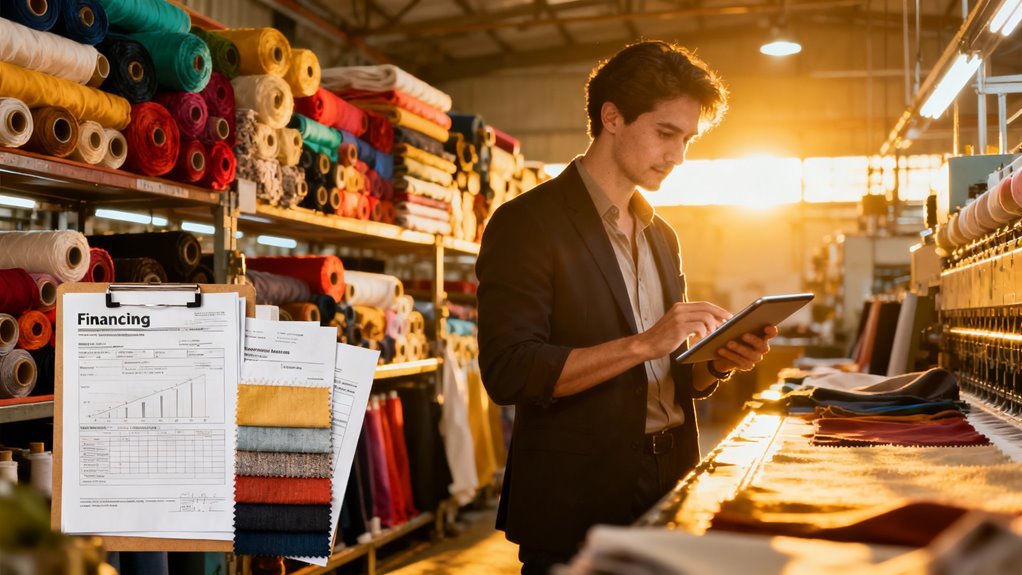
You’ve got the financing segment locked down, but here’s the matter: PO funding is just one thread in the bigger fabric for textile success. Smart brands like you combine financing with savvy operational moves:
- Streamline inventory by focusing upon best-sellers and ditching slow movers
- Diversify suppliers across multiple countries to dodge tariff surprises
- Invest in direct-to-consumer channels where margins remain fat and customers stick around
- Embrace sustainability because retailers demand it, and eco-conscious buyers reward it
When you merge PO financing with these strategies, you’re not just funding orders. You’re building resilience. You’re scaling confidently while competitors scramble. Your margins remain healthy, your supply chain stays flexible, and your brand stays independent. That’s dressing for success.
Frequently Asked Questions
Can I Use PO Financing if My Personal Credit Score Is POor?
Yes, you can. PO financing evaluates your customer’s creditworthiness, not yours. As long as your retailer’s credit is strong and you’ve got healthy margins, your personal credit score won’t disqualify you from funding.
What Percentage of My PO Value Will Lenders Typically Fund?
You’ll typically access 75-85% of your invoice value once goods ship. Lenders calculate funding based upon what they directly pay your suppliers, so your employed funds determine the exact percentage you’ll receive per transaction.
How Quickly Can I Access Funds After Submitting a Purchase Order?
You’ll access funds in 7 up to 14 days from application submission. Domestic suppliers receive payment within 1 up to 5 business days post-approval, while international transfers may extend for one week longer due to currency processing.
Are There Hidden Fees or Factors Beyond Interest Rates I Should Know?
You’ll face monthly fees (1-6%), due diligenceComprehensive appraisal of a business undertaken by a prospe charges ($200+), early termination penalties, minimum usage requirements, and international wire fees. Duration-based costs escalate beyond 30 periods. Factor these in before committing.
Can Sustainable or Eco-Certified Textile Orders Qualify for Better Financing Terms?
You’ll absolutely access better terms with eco-certified orders. Lenders offer reduced interest rates, larger loan amounts, and quicker approvals when you’re scaling sustainable materials. Your green credentials become your competitive financing advantage.

Gerry's commitment to helping businesses thrive is evident in his track record of providing tailored financial guidance. He understands the unique challenges that companies face and is dedicated to finding innovative solutions to support their growth.
When he's not working with clients or exploring the dynamic world of business financing, Gerry enjoys staying updated with industry trends and sharing his insights through informative articles. His passion for empowering businesses with financial knowledge is a driving force behind his work.
Connect with Gerry Stewart to tap into a wealth of financial expertise and unlock opportunities for your business's success.